
Most requests for research start with a method: "We need a survey" or "Let's do some focus groups." The better place to start is the decision. What will you do differently depending on the answer? Once that's clear, the method usually picks itself.
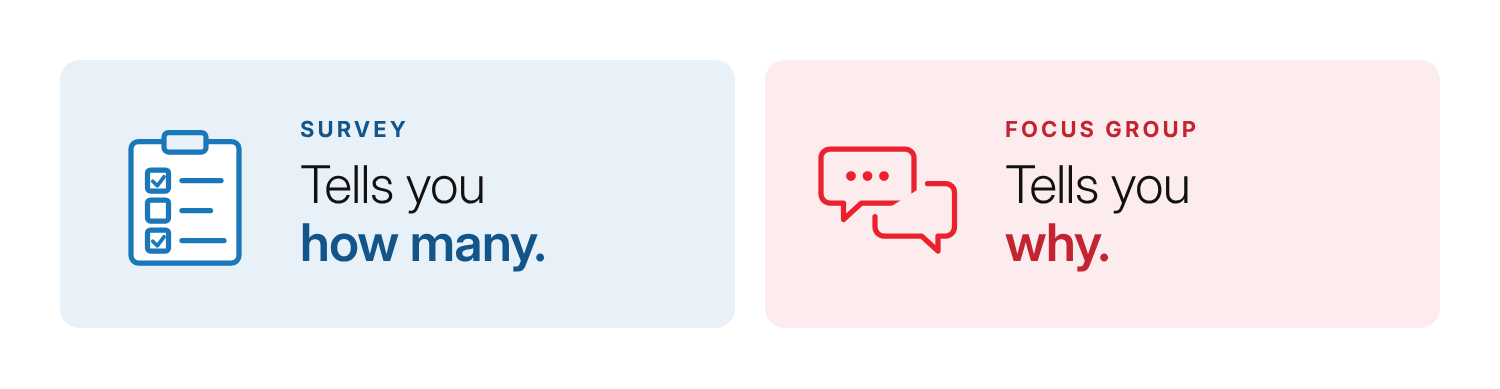
The short version: a survey tells you how many. A focus group tells you why.
When a survey is the right call
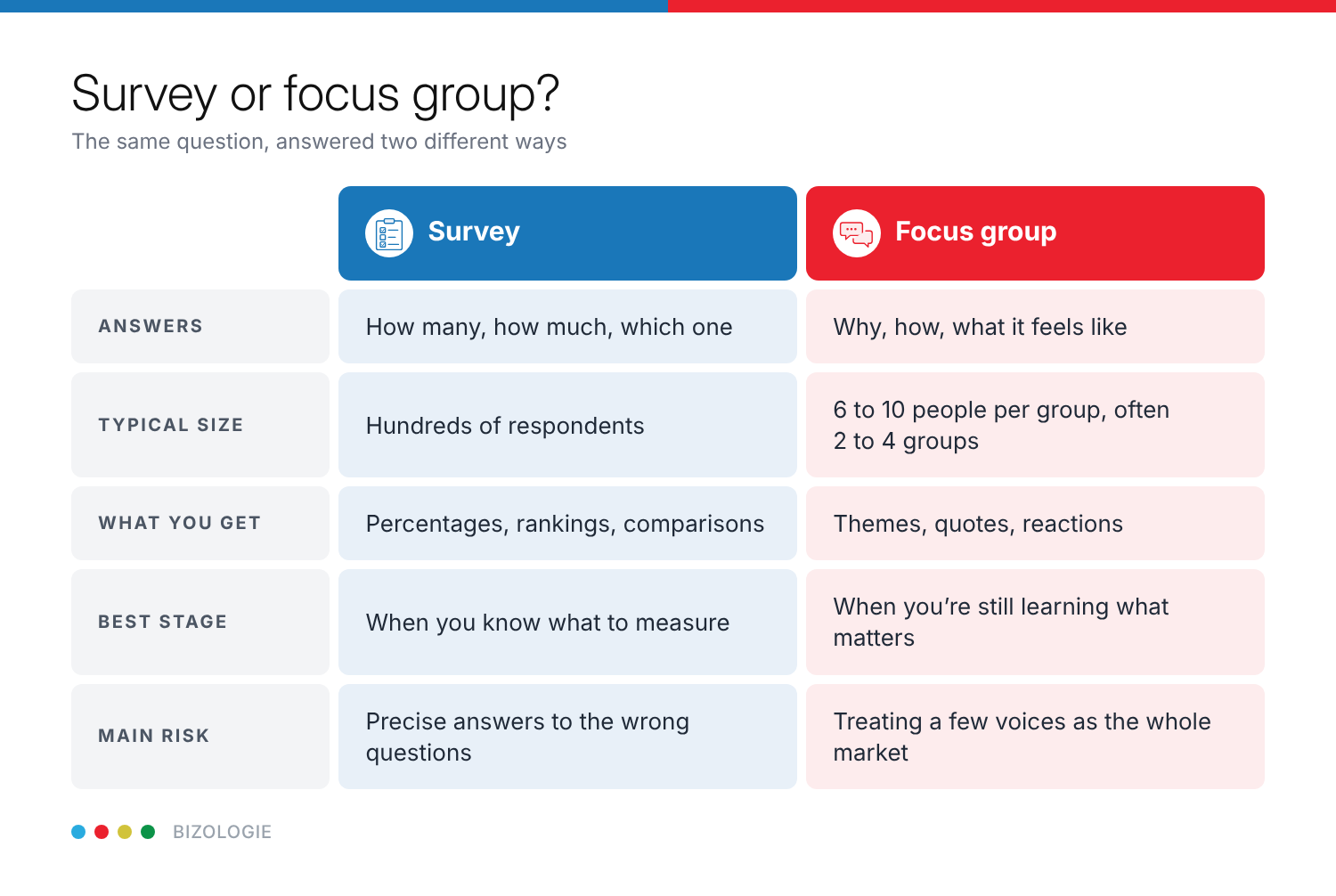
A survey asks many people the same questions in the same way, so the answers can be counted and compared. Choose a survey when you need a number you can defend.
Sizing: what share of customers would consider switching, or how many households own the product.
Ranking: which of eight features matters most, or which message scores highest.
Comparing groups: how first-time buyers differ from move-up buyers, or one region from another.
Tracking: whether satisfaction or awareness moved since last year.
When we surveyed 500 electric and plug-in hybrid owners about charging at home, the goal was to measure how common each charging setup was and how many owners were open to selling power back to the grid. Those are counting questions, and a survey answers them well.
When a focus group is the right call
A focus group brings six to ten people together for a moderated conversation, usually 90 minutes to two hours. Nobody leaves with a statistic. They leave with reasons, language and reactions that a checkbox can't capture.
Motivation: why people chose you, or why they almost didn't.
Language: the words customers actually use for the problem you solve.
Reactions: how a concept, ad or floor plan lands before you spend money on it.
Surprises: the issue you didn't know to ask about.
In focus groups we ran for a Texas land developer, homeowners explained what made them choose one master-planned community over another, and which marketing they remembered months later. Sales records showed which homes sold. The groups showed why.
When neither one fits: one-on-one interviews
For business-to-business questions, the right answer is often neither. Engineers, buyers and specifiers are hard to gather in one room, and they won't speak candidly in front of competitors. Many of them also aren't reachable through survey panels.
In-depth interviews solve both problems. When an equipment manufacturer wanted to know how gas utilities choose valves, we interviewed the engineers who make those decisions one at a time. Each conversation went deep on that person's own process, and the analysis across all of them showed the patterns.
Using both
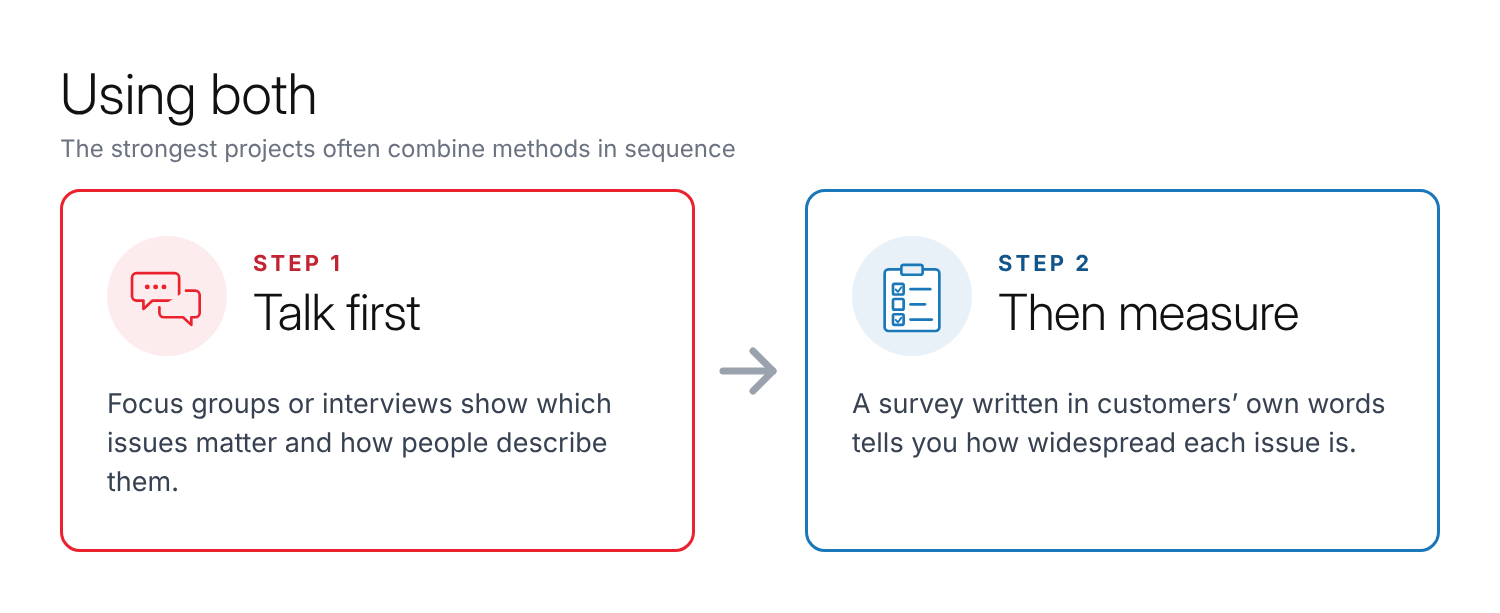
The strongest projects often combine methods in sequence:
Talk first. Focus groups or interviews show which issues matter and how people describe them.
Then measure. A survey written in customers' own words tells you how widespread each issue is.
Going in the other order works too: a survey result that raises a question ("Why do 40% of buyers rule us out?") is a good brief for a round of conversations.
Common mistakes
Counting focus group votes. "Seven of eight people liked it" is not a finding. Eight people can't stand in for a market.
Leading survey questions. "How much did you enjoy our new design?" assumes they enjoyed it.
Asking people to predict the future. People are poor at forecasting their own behavior. Ask what they did last time.
Talking to the wrong people. A well-designed study with the wrong participants gives confident, wrong answers. Recruiting is where most of the quality is won or lost.
How Bizologie can help
Bizologie is an Austin research firm. We design and run surveys, focus groups and one-on-one interviews for agencies, manufacturers, developers and engineering firms. That includes recruiting hard-to-reach participants, writing the questions with you, moderating and delivering the analysis.
If you have a decision coming up and aren't sure which method fits, tell us about it. We'll recommend an approach, even if it turns out you don't need us.