You wouldn't hand a client a half-baked soufflé. So why hand them half-baked research?
Great business research, the kind that actually moves the needle on a product launch, a brand pivot, an investment decision, or a market entry, isn't a Google search. It's not a ChatGPT prompt, either. It's a recipe. And like any good recipe, it requires the right ingredients, the right technique, and someone who knows when something smells off.
The questions we get asked at Bizologie are as varied as the clients who ask them: How big is our total addressable market? Why are customers choosing a competitor's product over ours? What do residents actually think about this neighborhood? How should we talk about our brand? The recipe looks a little different every time, but the kitchen is always the same.
Here's how we make it.
The Pantry: Our Research Toolkit
Before we start cooking, we stock the pantry. These are the tools and databases we draw from on every project, and why each one matters.
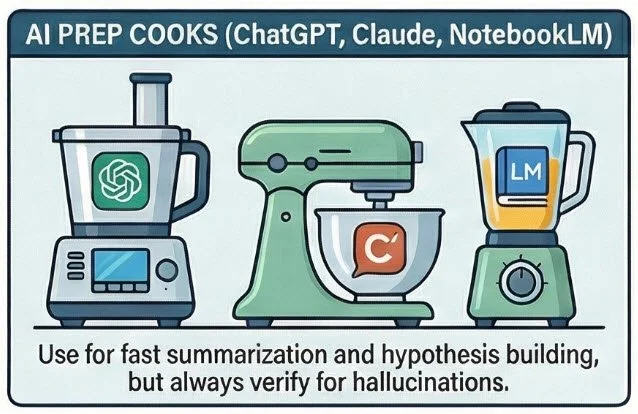
AI Tools (ChatGPT, Claude, NotebookLM) Think of AI as the prep cook. It's fast, it can summarize large amounts of text quickly, and it's great for early-stage hypothesis building. But AI can hallucinate confidently serving you a "fact" that simply isn't true. It also can't access proprietary databases, paywalled content, and even when it can search the web, it has no way to evaluate whether a source is authoritative, current, or complete. We use AI deliberately and verify everything it touches.
Capital IQ Our go-to for financial data on public and private companies including revenue, ownership structure, M&A history, and more. Essential for understanding a company's financial health or identifying acquisition targets.
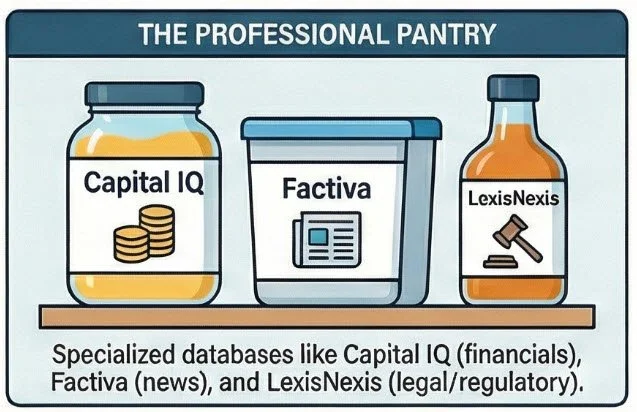
Factiva A deep archive of global news and business press. When you need to know what a company's CEO said in 2019, or track how a brand's narrative has shifted over time, Factiva is where we go.
LexisNexis Legal filings, court records, regulatory actions, and company profile information. This is how we find the things companies don't put in their press releases.
Investment Bank Research Analyst reports from major investment banks offer industry-level insight you won't find in mainstream press including market sizing, competitive dynamics, growth forecasts. We use these to provide sector context that sharpens our findings.
Industry Trade Publications and Association Data Every industry has its own trade press and professional associations. These sources give us on-the-ground intelligence about what practitioners actually care about, not just what shows up in a Bloomberg headline.
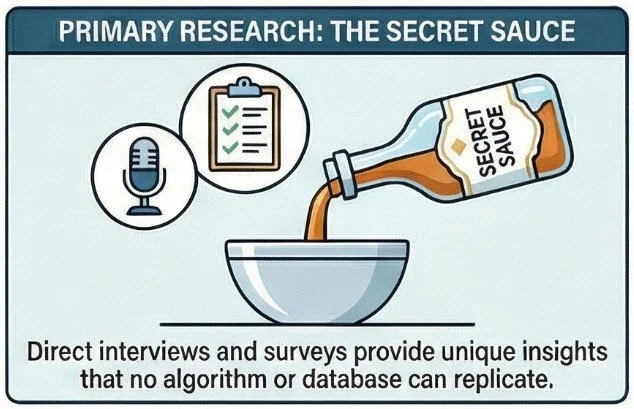
Primary Research Sometimes the most valuable ingredient isn't in any database. We conduct interviews, surveys, and focus groups when the question can only be answered by talking to real people. No algorithm replaces a candid conversation with someone who works in the industry.
The Recipe: Step-by-Step
Step 1: Define the Dish
Before we touch a single database, we ask: What decision does this research need to support?
The answer shapes everything. A PE firm evaluating an acquisition needs something fundamentally different from a food brand rethinking its messaging, a public company preparing a product launch, or a real estate developer trying to understand why people chose to live in a particular neighborhood. We've worked on all of these, and the common thread isn't the deliverable, it's the discipline of starting with a real question.
We don't research in a vacuum. We research to answer something specific, so the output is actionable, not just informative.
Step 2: Know Your Terrain
Once we know the question, we orient ourselves. Depending on the project, this might mean building a profile of a company, mapping a market, understanding a product category, or getting our bearings in an industry we're about to go deep on.
Think of this as the mise en place — everything in its place before the real cooking starts. We pull from Capital IQ, Factiva, and LexisNexis to build a factual foundation, and we use AI to quickly synthesize publicly available information, which we then verify. We never skip this step, even when clients think they already know the landscape. They're often surprised by what turns up.
Step 3: How Big Is the Opportunity?
Before you can evaluate a competitor, launch a product, or make an acquisition, you need to know what you're actually playing for. Market sizing,understanding the total addressable market and where realistic share exists, is one of the most valuable and most frequently undercooked parts of any research project.
We use investment bank research, industry association data, government sources, and trade publications to build TAM estimates that are defensible, not just directional. We also look at how the market is segmented, which pockets are growing, and where the white space is. Whether you're a PE firm stress-testing a deal thesis or a marketing team making the case for a new product line internally, this is the ingredient that makes everything else make sense.
Step 4: Map the Competitive Landscape
Who are the real players in this space? Not just the obvious ones, the ones that show up in board presentations. We identify the full landscape: direct competitors, adjacent players, emerging disruptors, and sometimes the quieter companies doing interesting things under the radar.
This step often surprises clients. The competitor they're most worried about isn't always the one that deserves the most attention.
Step 5: Go Deeper on Products, Pricing, and Go-to-Market
Once we know who the players are, we dig into how they compete. What products or services are they offering and how do they compare feature by feature? What are they charging, and how is their pricing structured? What channels are they selling through? How is their messaging evolving and where are they putting their marketing dollars?
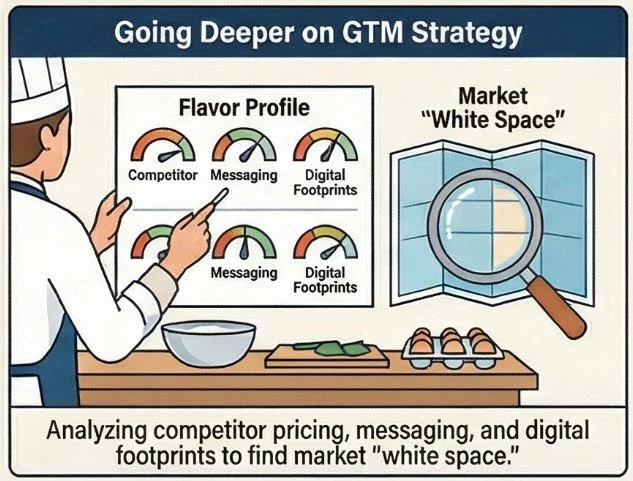
We track press releases, executive interviews, job postings (a surprisingly rich signal for where a company is heading), and ad creative. We also look at digital footprints like review sentiment and social presence to understand how a brand is actually landing in the market versus how it thinks it's landing.
For companies launching new products, this step is often the whole project: a rigorous side-by-side of how competitors have positioned, priced, and marketed comparable offerings, so you can make smarter decisions before you go to market.
Step 6: Understand the Customer — In Their Own Words
Secondary research tells you what customers have said. Primary research tells you what they actually mean.
We use both. Reviews, survey data, online community research, and industry reports give us a broad read on customer sentiment, unmet needs, and what's driving switching behavior. But when the stakes are high enough, or the question is nuanced enough, we go talk to people.
We've conducted focus groups with neighborhood residents to understand why they chose where to live, helping a real estate developer make smarter decisions about positioning future properties. We've gathered customer feedback that helped a food company completely reimagine how it talks about its brand. We've conducted interviews and surveys to understand consumer behavior at a granular level — including, yes, how strongly Texas residents feel about buying Texas shrimp.
The point is: sometimes the insight that changes everything isn't in any database. It's in a room, with real people, answering real questions. We know how to get it out of them.
Step 7: Read the Macro Environment
Individual companies and customers don't exist in a vacuum. Regulatory shifts, demographic changes, supply chain pressures, technology disruption, cultural trends — these shape what's possible and what's at risk in any market.
We use investment bank analyst reports and trade data to situate our findings in the broader context. This is especially important for PE due diligence, where a target company might look great in isolation but faces real headwinds at the industry level. It's equally valuable for marketing teams making multi-year bets on category growth.
Step 8: Synthesize and Pressure-Test
Here's where human judgment comes in, and why this step can't be automated.
We don't just compile findings. We look for patterns, contradictions, and gaps. We ask: Does this hold up? What would have to be true for this conclusion to be wrong? We triangulate across sources. If something looks off, we dig deeper rather than paper over it.
Then we distill it all into a clear, decision-ready report.
What Comes Out of the Oven
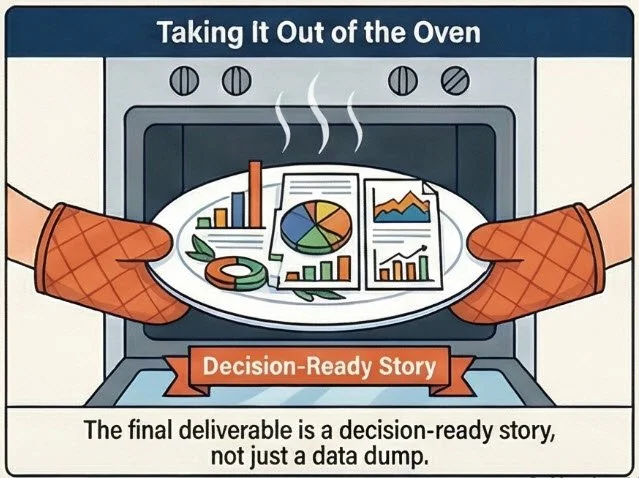
A Bizologie deliverable isn't a data dump. It's a story that answers your specific question, supported by rigorous sourcing you can stand behind in a boardroom, a pitch meeting, or a brand planning session.
That might look like a lot of different things depending on who you are and what you're trying to do:
For PE and corporate development teams, it's the due diligence layer that turns "this looks promising" into "here's exactly why and here's what to watch out for." We can size the market, profile the leadership, map the competitive landscape, and flag the risks that don't show up in the deck.
For marketing teams at public or private companies, it might be a side-by-side product and pricing analysis that tells you exactly how competitors are positioned before you go to market — or a TAM analysis that helps you make the internal case for a new category investment.
For brand and strategy teams, it might be the customer research that tells you why your messaging isn't landing, and what language actually resonates with your audience. We've helped companies completely rethink how they talk about themselves based on what customers told us directly.
For ad agencies, it's the research that makes your creative brief airtight and your strategy defensible; the kind of insight that earns client trust before a single concept is presented.
The format changes. The rigor doesn't.
Why Not Just Use AI?
We get this question a lot. The honest answer: AI is part of how we work, and it's made us faster. But speed without accuracy isn't a feature, it's a liability.
AI doesn't have access to our licensed databases. It can't call a source. It doesn't know what it doesn't know. And it has no skin in the game when a report lands in front of a partner, a CMO, or a board.
We do. That's the difference.
Bizologie has been cooking up competitive intelligence since 2014. If you're hungry for research that actually drives decisions, let's talk.