
Google recently launched Recipe View and while it's not quite perfect yet, it seems like it will be a nice way to search. You simply search for a food, ingredient or holiday and then click "Recipes" on the left side of the page. This limits your search to only recipe sites so you won't search for hamburgers and get an article about hamburgers or a restaurant site. Once you've got your list of recipes, you can limit by number of calories or preparation time. I also like that you can limit by ingredient, so if I want to make a birthday cake for a friend who hates coconut, I can limit my search to cakes without coconut. One thing to be aware of, especially if you run a food blog (or like food blog recipes), is that you need special coding on your site to make sure you're listed in Recipe View. You can find instructions here.
St. Patrick's Day - Spending o' the Green

We may not all be Irish but that doesn't stop us from celebrating St. Patrick's Day. According to the National Retail Federation over half of Americans will take part in the holiday. That's 122 million people going to parties, decorating with four-leaf clovers, drinking green beer, and eating green mashed potatoes. Total spending for the green day is expected to reach $4.14 billion! My favorite St. Patrick's Day treat is the McDonald's Shamrock Shake. To learn more about the famous shake, including history, old ads, and nutritional facts (I'll warn you, you may not really want to know about that), check out the Ultimate McDonald's Shamrock Shake Guide. If you want to get yourself some of the minty goodness today, check out the Shamrock Shake Locator to see if they have been sighted in your area.

March Madness: The Big Dance for Advertisers

It's March Madness and while we can't help you with your brackets, we can help you research the dollars and cents of college basketball. According to Kantar Media, about 280 marketers have spent over $4.8 billion on national television advertising during March Madness over the past decade. In 2010 alone, ad revenue topped $613 million, up 4% over 2009. And since games are streamed online, digital advertising represents a small but growing segment of March Madness advertising. Digital advertising represented only 1% of the ad revenue for 2006, but grew to almost 6% in 2010. The NCAA playoffs are also the #2 most lucrative post season sports franchise for ad revenue, ranked only behind the NFL playoffs. Top advertisers included GM, AT&T, Coke, Capital One and HP. Speaking of Coca-Cola, this is a big year for their Powerade division. According to AdAge, Powerade will launch its biggest marketing program yet as this year's "Official Sports Drink of the NCAA". Powerade products will be on the sidelines for all 88 games and they'll launch their new "Game Science" campaign during the first game with an ad featuring Chris Paul from the New Orleans Hornets. Powerade currently holds about 27% of the sports drink market share with Gatorade leading the category with 71%.
Estrogen Based Entrepreneurs
Bizologie is proud to be a new member of Estrogen Based Entrepreneurs. Jill Murphy started the Facebook page after writing a blog post about the challenges of the entrepreneurial/creative life. One of her friends, Sara-Mai Conway, reposted it on her page with a note about how she was going through the same thing as well. At the same time, Jill was launching My Close Strangers and another friend Bess Eckstein was starting At Your Service. Jill thought that Estrogen Based Entrepreneurs would be an excellent way to connect women who were working on new ventures so they could commiserate, share info, support each other. What a great idea and a super way to meet some awesome entrepreneurs!
Jill is embarking on quite an adventure with her My Close Strangers project. Over the next 18 months, she will be walking, biking, driving, and flying to coffee shops, restaurants, and bars across the country to sit down with as many of her US-based Facebook friends as possible. She is interested in learning "how to be a good neighbor in a world where neighbor is being redefined in real time." We hope to meet Jill on her travels.

Happy Pie Day! Er, Pi Day?

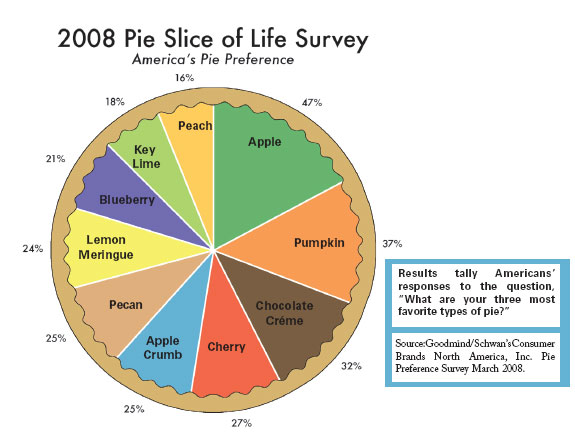
Since my geometry days are a few years behind me, I thought we'd celebrate Pie Day instead by taking a look at the business of pie. While other industries struggle during a recession, the pie industry is, according to Mark Grandanetti, president of Rocky Mountain Pies, recession-proof. According to Baking Management, the sales of fresh baked pies topped $222 million for the 52 weeks ending January 24, 2010. That's about 6.7% higher than the previous year's sales. So while Americans may be dining in more often, they still like to splurge and enjoy dessert at home. Pie sales in all categories including fresh, refrigerated and frozen all increased over the previous year. And what's our favorite flavor of pie? Apple is in the lead with 47% of those surveyed saying they prefer it best:
Casual Friday: Austin Margaritas in Google Fusion Tables

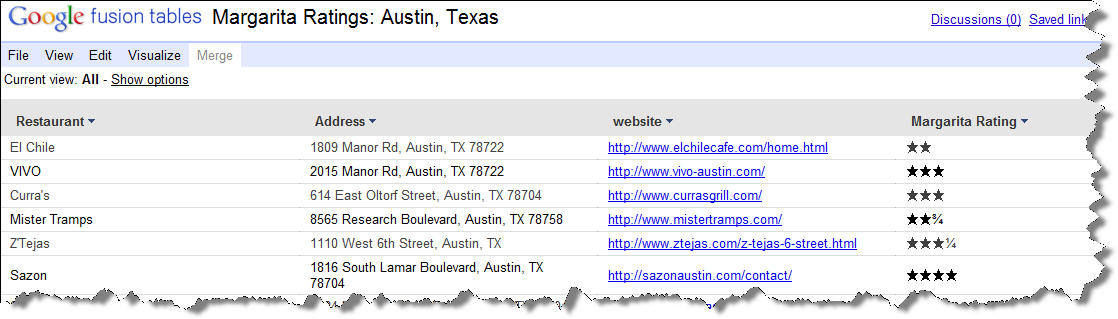
Amy Rushing, Metadata Librarian extraordinaire, shows bizologie how to put Google Fusion Tables to good use. Amy has spent two years testing margaritas around Austin and rating them. Using Google Fusion she has given us Margarita Ratings: Austin, Texas - a map of restaurants and their margarita rating. You can see her rating scale in the File>About section of the Table. With Google Fusion you can create charts, graphs, and all sorts of different visualizations including maps. And, you don't have to be a metadata librarian to do it. It's easy. To create a map, make a spreadsheet with the data in Excel or Google Docs. One of the columns has to be address with zip code to map the locations. Amy used HTML code to create to the stars and fractions for her ratings. Then just import the spreadsheet into Google Fusion.
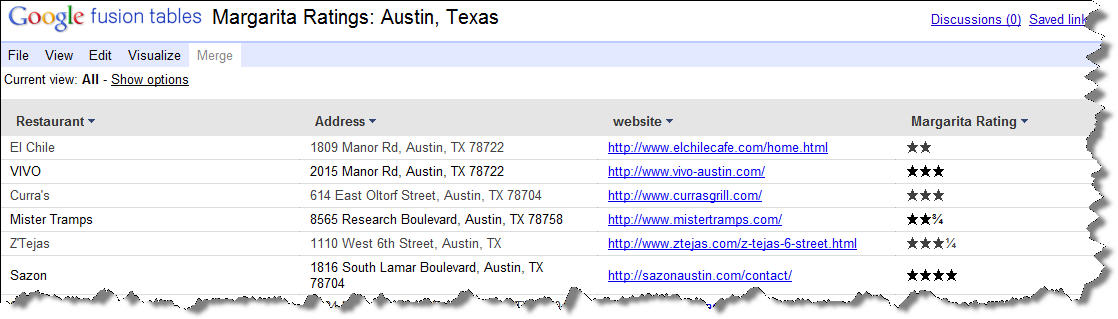
Let us know if you are inspired to use Google Fusion to map your passion. We'd love to see your masterpiece. And, Amy, we here at bizologie commend you and hope you continue your good work.
Corporate Use of Social Media
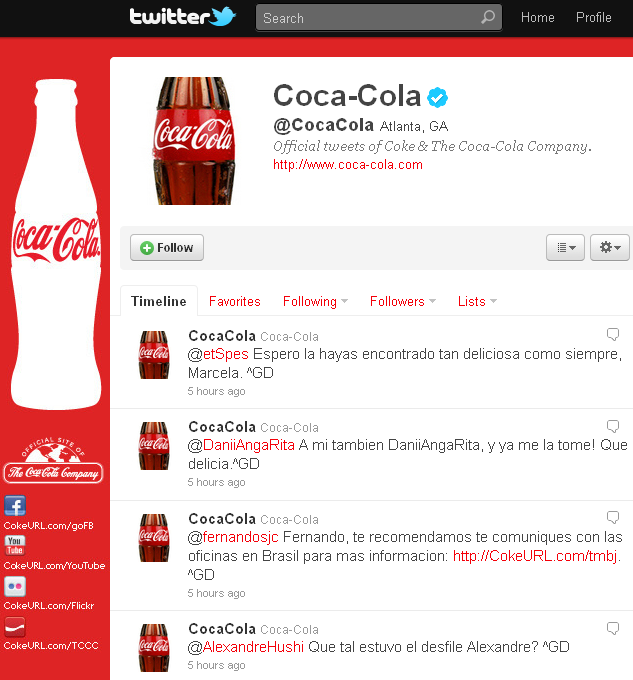
Recently we talked about how SMBs are using social media and today we're going to take a look at how some of the larger corporations put social media to work for them. Burson-Marsteller has a great report out entitled "The Global Social Media Check-up 2011". It's a great report and gives us insight into how some of the Fortune 100 companies use Facebook, Twitter, YouTube, blogs, etc. Over the past year, they report "an 18% increase in FortuneGlobal 100 companies using Twitter, followed by a 14% growth in YouTube channels and a 13% growth in companies using Facebook pages." And typically corporations have more than one account: On average they have 5.8 Twitter accounts, 4.2 Facebook accounts, 2.7 YouTube channels and 6.8 blogs. IBM alone has 76 Twitter accounts! That's a lot of communication, but who's listening? Corporate accounts average about 5,076 followers on Twitter and 87,979 "likes" on Facebook. According to eMarketer, most people follow a brand "to get updates on future products":

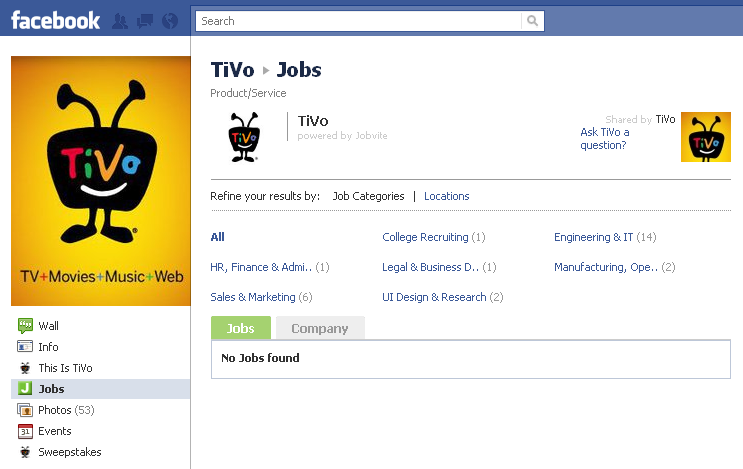
Fans and followers can get anything from customer service to a new job. TiVo is among the many companies who post jobs on their Facebook page:
And Glaceau's smartwater is hoping their new YouTube video will go viral:
The Yoga Market

Since I skipped my yoga class, I'm covering the yoga market to make up for it. If you have never taken a yoga class you might think it's breathing, stretching, hippy nonsense, but if you belong to a hip studio, have all the latest towels, mats, props, and stylish workout clothes, you know that yoga is big business. A $6 billion business to be exact. According to the 2008 Yoga In America Study released by Yoga Journal, these yogis are a pretty affluent group. Of the US yoga practitioners 44% have household incomes of more than $75,000 and 24% earn more than $100,000. Business Week reports the latest craze to hit the market is trademarked yoga styles. You have probably heard of Bikram yoga - the sequence of 26 poses practiced in 105F heat. In 2002 Bikram Choudhury trademarked and copyrighed that yoga style and now "charges fees for instructor training ($10,900), studio setup ($10,000), and franchise royalties (up to 5 percent of gross monthly revenues)—all contributing to $5 million in annual revenue." With results like that others were sure to follow. Since 2001 more than 2,000 trademarks have been filed relating to yoga styles and products. A lot of these styles appeal to a certain non-traditional yogi or to anyone who doesn't have a lot of time. Now you can practice BROga®, Circus Yoga®, Snowga®, and my new favorite Hillbilly yoga®.
On a side note the Indian government doesn't take to kindly to what it calls yoga theft. "Since 2001 their government has been cataloging more than 1,000 postures in a compendium created to protect against intellectual property infringement." It doesn't seem to be stopping anyone though. The creators of the styles claim that although they didn't invent the forms they invented a new style or sequence of how they go together. Even if the courts one day decide you can't trademark yoga, there are still lots of books, clothes, props and classes still to be sold.
Namaste
It's Mardi Gras--Let The Good Times (And the Money) Roll

Today you're probably thinking about King Cakes, Hurricanes and beignets, but we at bizologie are thinking about the business side of Mardi Gras. Ok, maybe we're thinking a little bit about King Cake. In a report commissioned by the Carnival Krewe Civic Fund and conducted by Tulane University, the 12 day festival has a significant economic impact on the city of New Orleans. Here's how the numbers break down:

The city's return on investment, including brand value (money spent outside the Mardi Gras season), is $4.48 for every dollar spent. Additionally, Mardi Gras represents over 1% of the city's GDP--that's 1% in just 12 days!


SMBs Double Use of Twitter
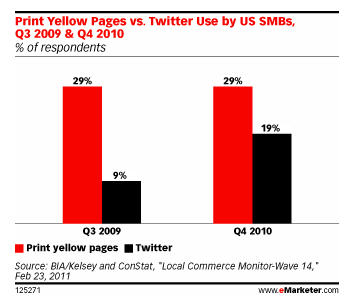
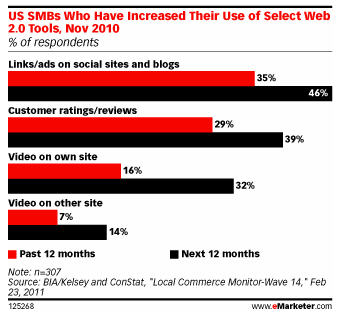
eMarketer reports that small and medium-sized businesses doubled their Twitter usage from 2009 to 2010. According the the “Local Commerce Monitor-Wave 14” study from BIA/Kelsey and ConStat, last year 1 in 5 SMBs used Twitter for local marketing. SMBs' overall use of social media is growing. "Twitter was still behind many other social media tactics, with nearly half (48%) of respondents using Facebook for marketing and a quarter using some other social network." 35% of the SMBs surveyed had increased their use of links and ads on social media sites over the past year, and "46% planned further increases in the next 12 months." 25% of SMBs increased their use of customer ratings and reviews in 2010 and 39% expected to increase usage of reviews before the end of 2011. Not surprisingly, younger businesses (those under 7 years) were more likely to use social media for marketing.
For more on corporate uses of social media, stay tuned to bizologie. Later this week Laura will cover The Global Social Media Check-up 2011 report from Burson-Marsteller.
Make Your City Smarter With IBM's City Forward

IBM's City Forward just launched and it's a wonderful free resource for aggregating data about cities all over the world. Using data from publicly available resources (e.g. U.S. Census Bureau, Australia Bureau of Statistics, EuroStat, UK National Statistics, etc.), City Forward allows users to "gain insight into urban issues such as transportation, energy, health, education and the environment." Using the data provided, users create "explorations" showing patterns and correlations within that data. Starting from their explorations tab, users enter the city or cities they want to explore combined with subjects of interest like transportation or health and then choose how they'd like to see the data presented. There are several explorations already created and even a community page to discuss explorations or provide troubleshooting. Check out the video below to see City Forward in action.
Casual Friday: bizologie’s Favorite Travel Apps

It's Friday and we're dreaming of a weekend getaway and planning our summer vacation. Whether you're taking a road trip close to home, summering in the Hamptons or grabbing your passport for a European getaway, your smartphone can be your best travel accessory. From translating foreign languages and calculating currency exchanges to alerting you to speed traps and picking a subway route, travel apps provide tools for just about anything you need. Here are a few we think are pretty great:
- Word Lens--Translates signs from Spanish to English (and vice versa). Simply open the app and hold it up to the sign you want to translate. Check out the video below to see Word Lens in action. Available for iPhone only; Android is in the works.
- Free WiFi Finder--True to its name, this app helps you find WiFi locations all over the world indexing both free and paid hotspots. The best thing is that you can download the directory to use offline. Perfect for locating WiFi in international locations when you don't want to use that expensive international data plan. Available for iPhone & Android.
- Hear Planet--Audio guides of tourist destinations all over the world. Includes geolocation so you can hear about what's nearby. Requires a data connection so probably not a good choice for international travel. Available for iPhone & Android.
- HopStop--Public transportation and walking directions for several big cities with more on the way. I've been using this one for years when I travel to NYC for instant subway directions. Available for iPhone & Android.
- Frommer's Travel Tools--This is a nice little one-stop-shop app which includes a currency converter, a time translator, a packing list and a few other handy tools. Available for iPhone only.
- Siri--One of my all time favorite apps, Siri is like having your own personal assistant. Simply tell it what you're looking for (a taxi, some ice cream, a movie) and Siri does it for you. I've used this for calling a taxi in an unfamiliar city before. Siri knows your location, contacts the cab company and texts you the name of the driver. Before you know it, your cab has arrived and all you did was utter the word "taxi". Brilliant. Available for iPhone only.
- Simply Postcards--We've covered this one before, but it's worth repeating. Send any image as an actual postcard right from your phone. Snap your picture, enter a friend's address and let Simply Postcards do the mailing. Love it! Available for iPhone & Android.
- trapster--Alerts you to speed traps in your area. Use it for your daily commute or a cross country road trip. Available for iPhone & Android
- TripIt--Organizes all of your flight numbers and hotel reservations. I like that TripIt allows you to forward confirmation emails from airlines, etc. and then imports them easily into an itinerary. Available for iPhone & Android.
- GateGuru--Helps you locate airport restaurants, shops and other amenities not only by proximity but by reviews as well. Available for iPhone only.
- xe--Free mobile currency calculator. You can store the latest updated rates for offline use. Available for iPhone & Android.
- Google Translate--"Allowing users to speak to translate in 15 languages and to translate words and phrases into more than 50 languages. You can also listen to your translations spoken aloud in 23 different languages." Available for iPhone & Android.
- Trip Case--Organize your hotel, flight and car rentals all in one place. TripCase will also alert you to flight or gate changes and offer alternative flight choices if your flight is canceled or changed.
- Help Call--With 126 countries supported, Help Call gives you up-to-date international Police, Fire Department and Ambulance phone numbers. Available for iPhone only.
- FlightBoard--Arrivals and departures in real time. FlightBoard's design was "based on the flight board at Charles de Gaulle Airport to give the app a beautiful, old school look." Available for iPhone & Android.
Happy Trails!
What's Cooking in the Restaurant Business?

With over $604 billion in sales annually, the restaurant industry has a big impact on our nation's economy. The National Restaurant Association's website is a great place to start when researching restaurant statistics and trends and they make it easy for us with a link to their research right at the top. Here you'll find national, as well as state, restaurant facts. Here are just a few of the facts freely available:
- There are 960,000 restaurants in the U.S.
- 12.8 million people are employed in the restaurant industry making it one of the largest private-sector employers
- 80 percent of restaurant owners started their industry careers at entry-level positions
- In 2010, Hawaii’s restaurants are projected to register $3.1 billion in sales.
- 47 percent of adults say they would patronize food trucks
- 69 percent of adults say they are more likely to visit a restaurant that offers food grown or raised in an organic or environmentally-friendly way
- In 2008, there were 38,596 eating and drinking places in New York
- $2,619 Average household expenditure for food away from home in 2009
- Restaurants employ 165,200 people in Oregon
- The overall economic impact of the restaurant industry is expected to exceed $1.7 trillion in 2011
The state reports even break down restaurants by Congressional District. For example, I can see in the Texas report that Lloyd Doggett's district has 1032 restaurants and 22,932 restaurant employees.
You can also find interesting restaurant trends. Each year, the National Restaurant Association conducts a Chef's Survey. Here you can find restaurant trends by category. In 2011, the biggest overall trend in restaurants is "locally sourced meats and seafood". The top trend in desserts is "Artisan/house-made ice cream" while the hottest thing in breakfast is" Ethnic-inspired breakfast items (e.g. Asian-flavored syrups, chorizo scrambled eggs, coconut milk pancakes)".

Who's in that zipcode?

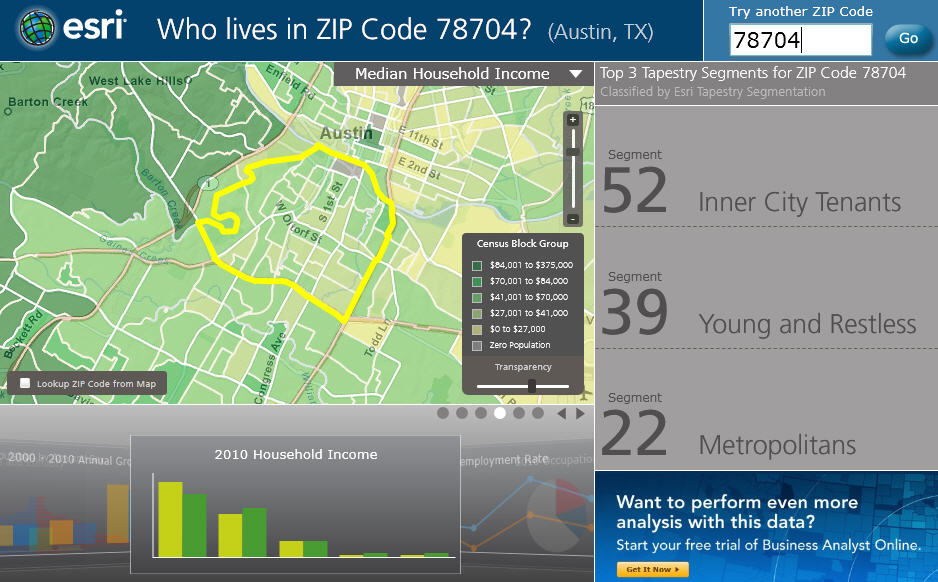
Free psychographic data down to the zip code level? It must be your lucky day. ESRI is a leader in GIS software helping people map and visualize data. They offer a wide range of products. With a zip code search ESRI provides the usual demographics (population by age and gender, household income, unemployment rate) and then to tease you and give you a taste of what they can offer, you get the top 3 neighborhood tapestry segmentations - for free! How does the 78704 zip code shake out? Well, it's made up of the Inner City Tenants, Young and Restless, and Metropolitans. The Metropolitans' medial age is 37.6, they own or lease a station wagon, listen to NPR, and have educational loans.
Finding an Email Address for a CEO

If you do business research for a living (which might explain why you landed here), chances are you’ve been tasked at least a time or two with waving your magic research wand to produce an executive’s email address out of thin air. Assuming you have, you’ve probably found that it isn’t quite as easy as just heading to the company website and plucking the address from there. Not only that, but the difficulty factor almost always seems to increase exponentially with the level of power or prestige held by the executive in question. Still, it’s not impossible. Far from it. In fact, here are few tips that may help you in your sleuthing: 1. If it’s a smaller company, do a WhoIs search on the company at GoDaddy or another domain registration service. A lot of times, there will be a contact person listed along with an email for them and often that person is the CEO, president, owner or what have you.
2. If it’s a big company, head to Google, Bing or the search engine of your choice (are there any others anymore?) for some background/personal information on that particular executive. Since these kinds of folks tend to have big bucks, their kids tend to go to private schools and they, in turn, often wind up on their boards, committees or what have you. Sometimes, following those leads can lead to to email addresses, as can seeking out information on country clubs or other private organizations they may belong to. In the past, I’ve found CEO addresses on everything from websites for soccer teams that executives coached their kids on to organizing committee contact lists for Fall festivals, Winter carnivals, etc. Your creativity will definitely come in handy here.
3. During your background information search, also try to see what boards these people serve on, be they corporate or non-profit (these tend to have a higher email address hit rate), as sometimes you can stumble on a document (add filetype:pdf to your Google search and see what you find) or a website that includes board members’ email addresses or other clues as to their contact information.
4. Rich people also often have their own foundations, which you can search for at places like Guidestar.org or Fdncenter.org. Here, you can search foundation profiles for contact information or examine the Form 990s these organizations have filed for additional clues that may well lead you to an email address.
5. Finally, don’t rule out going straight to the company’s website and digging around there. You might well be surprised by what you’ll find, especially if you dig through enough press releases.
Good luck!
Birthday Card Business

Happy Birthday to bizologie co-founder Laura Young! For the special day I thought I would cover the business of birthday cards. According to the Greeting Card Association, American’s spend $7.5 billion on greeting cards each year. Nine out of 10 U.S. households buy cards, with the average household purchasing 30 cards a year. Overall we purchase 7 billion cards. Sales are evenly split between seasonal and everyday cards. The most popular seasonal cards are Christmas and holiday cards, which account for more than 60% of all seasonal card sales, followed by Valentine’s Day, Mother’s Day, Father’s Day and Graduation cards. Everyday card top sellers are wedding/anniversary, get well/sympathy, and friendship/encouragement cards, but of course the most popular everyday cards are birthday cards which account for more than half of all the everyday card sales.
Casual Friday: Shoe Shopping

Want to do a little shoe shopping online? Of course there is Zappos and for discount shoes you can check out 6pm.com, but if you are looking for something a little different check out these 2 sites: ShoeDazzle is just the ticket if you are looking to spice up your shoe collection. This is a shoe of the month club and shoes are $40. You answer a short survey with questions about your style, age, who's celebrity closet you'd like to raid, etc. and then a day later ShoeDazzle sends you a personal showroom. The shoes are targeted to your style and picked just for you by celebrity stylists. Kim Kardashian is the co-founder and listed as the Chief Fashion Stylist. I somehow doubt she's in the backroom picking shoes, but there is a long list of stylists. My style was "classic modern" but the first showroom didn't have much I liked, so I had the option of answering a few more questions and getting a new showroom. When you place your first order you become a member. You have the option to opt out each month but you only have short window of time. Shipping and returns/exchanges are free though. The shoes are inexpensive, fun styles, more appropriate for a night on the town than the office, but it's just the site to get you out of a shoe rut in time for spring. Oh, and did I mention they have handbags and jewelry too?
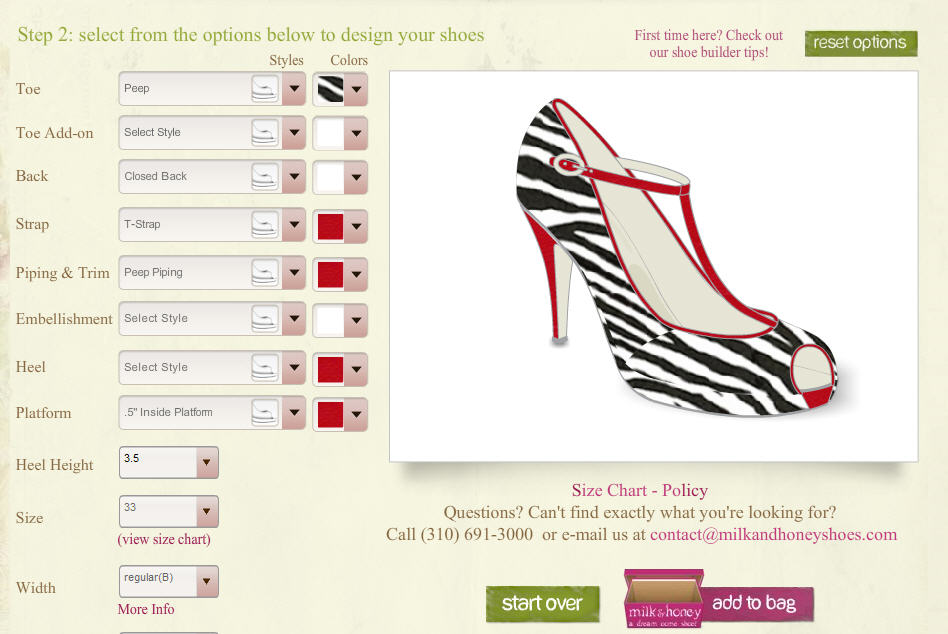
If your budget is no problem and you are feeling super creative, design your own pair of shoes at Milk & Honey Shoes. The peep toe pumps I designed (see below) were $290 and the flats were $245. Definitely not cheap, but this site would be great for a wedding or special event. Or just have fun and let your inner shoe designer out!
And The Oscar Goes To...The Business of The Academy Awards

The countdown to Oscar is on! Will it be The Social Network or The King's Speech? Natalie Portman or Annette Bening? Colin Firth or Jeff Bridges? Well, we can't help you with those questions, but we can offer a little insight on the business side of the Oscars. According to Kantar Media, over that last decade advertisers have spent over $720 million dollars during the Oscar broadcast. This year a 30 second spot will run about $1.7 million. Over the past five years, more than half of the ad revenue has come from only five companies: Coca-Cola, JC Penney, General Motors, American Express and MasterCard International. However, the recession has opened up the way for a few first-time advertisers who were responsible for about 48% of 2010's Oscar advertising. Hate commercials? Good news; the Academy Awards have limited commercial time: just 8-10 minutes per hour. The Super Bowl has about 13-14 minutes per hour while a normal broadcast television show has 14-16 minutes.
If you're looking for more research on the business of movies, the Motion Picture Association of America has a great Policy & Research section on their website. They provide industry reports showing the economic impact of the movie and television production industry as well as state by state statistics. The state statistics are great and show not only economic impact but also the number of movies and television shows filmed in each state as well as each state's production incentives. Fun facts from the site include:
- To qualify for incentives in Texas 70 percent of the production crew, actors and extras must be Texas residents
- The motion picture and television industry is responsible for 8,200 direct jobs and $268.6 million in wages in Oregon.
- In 2008, 26 movies were filmed in Florida
- To be eligible for incentives in Colorado, productions must spend at least 75 percent of expenditures in Colorado and 75 percent of the actors and crew must be Colorado residents.
- Over two-thirds of the population (68%) – or 222.7 million people – went to the movies at least once in 2010.
Our Mobile Payment Future

eMarketer reports that the world wide transaction value of mobile payments will be close to $1 trillion in 2014. That's 6x the current value of $162 billion. This forecast from Yankee Group includes transactions from mobile banking, international and domestic remittances, contactless cards, mobile coupons, and near field communications (swiping your smartphone near a payment terminal). IT World reports that IE Market Research predicts the value will be even higher at $1.1 trillion and they believe that 1/3 of that forecasted value will be made up of the NFC transactions. The GSM Association has over 750 carriers around the world and they are working on standardized mobile payment systems to make these forecasts a reality.
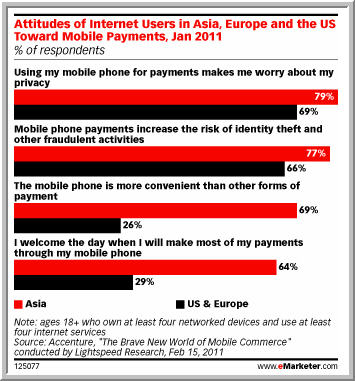
The idea of mobile payments hasn't caught on in the US just yet. Less than 10% of the those of us in the US have paid with our phones and only 29% of US and European respondents "welcome the day" when they can make payments using their phones, but IE Market Research shows that mobile payments are common in many other countries. For example, in Taiwan 32 % of users have made purchases via their phones. With Verizon, AT&T, and T-Mobile all hoping to roll out NFC services next year, mobile payments could become the norm in the US shortly.
Chomp: The Search Engine for Apps

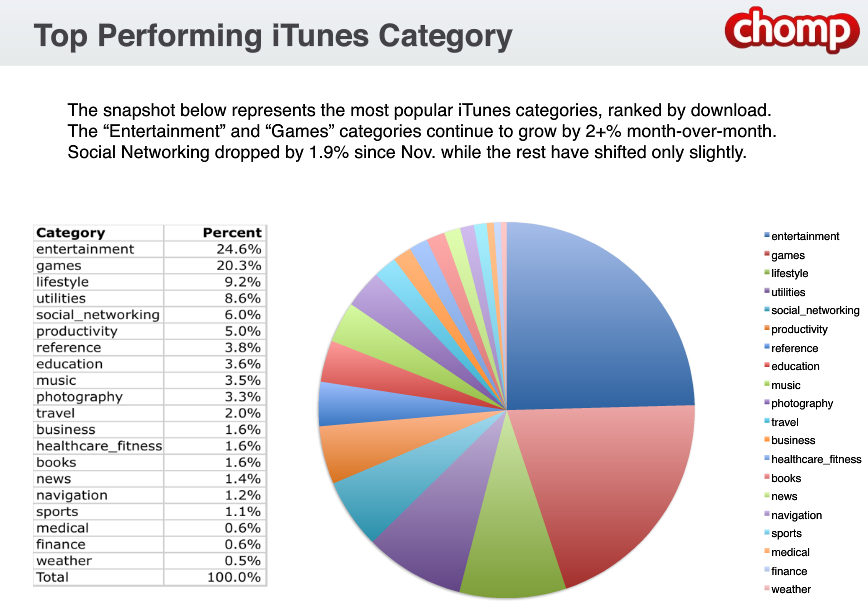
You know "there's an app for that". But how do you find it? Chomp is a new search engine just for apps. Instead of searching by app names you can search by app categories. If you're looking for games you can be really specific like "puzzle games" or "kids' games". Results are then displayed along with review ratings and one click takes you straight to the iTunes store. They've also got a great page full of "trending iPhone app topics". If you're looking for app stats, Chomp also produces "Chomp Charts" of usage trends, seasonal queries, app monetization and the "Chomp 55" which are the most downloaded and highest rated apps. "Chomp Charts" are in a nice slide show presentation that are free to download.
Of course, Chomp has its own app so you can search right from your phone.